It’s 2022 and we’re already thinking about the evolution of 5G Advanced to 6G

2022 has been an exciting year for mobile communications. Not only was the third 5G standard — 3GPP Release 17 — successfully completed bringing many 5G innovations, but the work on 5G Advanced has also officially begun. Through the rest of this decade, 5G Advanced will continue to improve end-to-end system performance, bring new efficiencies, and proliferate 5G into more devices and use cases. More importantly, 5G Advanced is establishing the technical foundation for 6G — the next-generation mobile platform coming in 2030 and beyond.
Today, the early vision for 6G is starting to emerge as mobile and the broader vertical ecosystems embark on foundational technology research preparing for the next decade of innovations. While we are still quite a few years away from commercial launches of the 6G platform, we are certain of one thing: 6G will bring technology leaps, new experiences, and use cases that we can barely imagine today.
Download the 6G Vision Presentation

6G motivations, capabilities, and applications
So, why will we need 6G? At a high level, there are three main driving forces: harnessing core technology advancements (in wireless and adjacent areas like semiconductors and materials science), meeting societal sustainability needs (economic growth, digital access, and green initiatives), and addressing new requirements for next-level experiences that cannot be met with 5G.
To efficiently meet these objectives, 6G will be a smarter platform that brings more than just a new radio design, it is envisioned to encompass a broader range of technologies to further drive the expansion of the connected intelligent edge at scale. 6G will fully unleash the combined potential of communications, artificial intelligence (AI), integrated sensing, system resiliency, and greener networks.
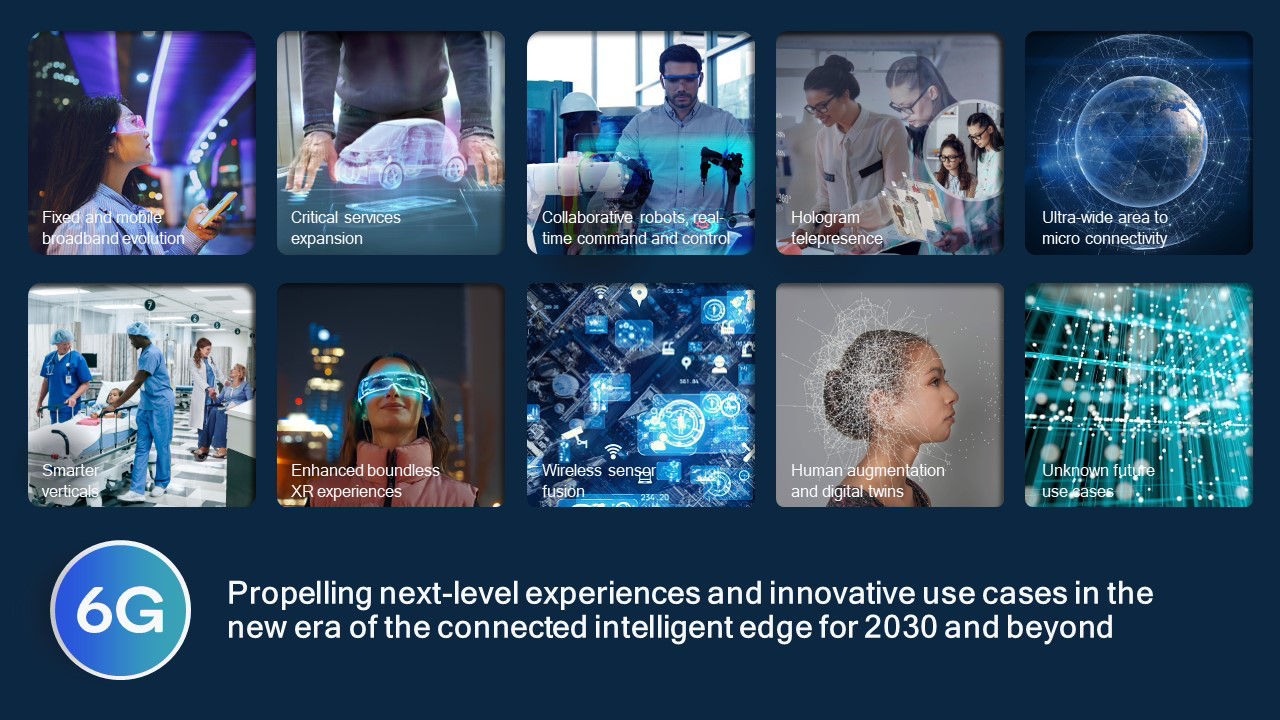
For use cases, 6G will evolve fixed and mobile broadband to support expanded capacity and higher speed. Pervasive access can provide ubiquitous connectivity, and real-time control will further enhance ultra-low latency, high-reliability communication. 6G will also deliver new classes of services, serving as a unified platform that can take human immersion to the next level. Advanced sensing will enable spatial perception services to further improve communication and enable new applications. Building on that technology progress, the 6G platform is expected to realize a broad set of industrial and societal benefits, further expanding the digital economy and delivering on improved sustainability.

Essential technology vectors on the path to 6G
Today at Qualcomm Technologies, we are driving longer-term research across a wide range of technical disciplines to lead the 5G Advanced evolution and establish the technical foundation for 6G. Let me summarize our key technology vectors.
Merging of the worlds: Future innovations can unlock more immersive experiences. We are rapidly pushing technology boundaries to take human augmentation to the next-level and more seamlessly merge the physical, digital, and virtual worlds. On the path to 6G, we will further enhance boundless XR, and tactile Internet, as well as enable low-power joint communications and sensing, and more.
AI-native end-to-end communications and sensing: A data-driven design will distribute AI throughout all protocols and layers, allowing the 6G system to efficiently improve as more data is collected. Key technologies can facilitate joint training, model sharing, and distributed inference across networks and devices, including federated learning that scales fully with 6G.
Scalable network architecture: Next-generation systems will bring processing capabilities even closer to the end user by disaggregating and distributing cloud processing across the connected intelligent edge. It is expected to serve broader application needs and further enhance open RAN (O-RAN) topologies with disaggregation and virtualization for more scalable, cost-effective, and adaptable networks.
Air interface innovations: A cutting-edge air interface design can deliver significant performance leaps in existing and new spectrum. Fundamental building blocks (waveforms, multiple access, channel coding) will need to address the exponential data growth with sustainable complexity and power efficiency. Example areas include full duplex, Giga-MIMO, reconfigurable intelligent surfaces, and more.
Expanding into new spectrum bands: A new spectrum paradigm can bring new spectrum and enable novel sharing and dynamic coordination techniques that better utilize existing spectrum. Opening upper mid-band (i.e., 7 to 24 GHz) and sub-THz band (beyond 100 GHz) can enable new use cases and deployments that require extreme capacity.
Communications resiliency: From cloud to network to device, there is an increasing need to support a higher degree of resilience in terms of security, privacy, availability, and more. Next-generation systems will build on a solid foundation to further enhance resiliency in anticipation of future challenges. Potential focus includes new and enhanced trust models, such as support for post-quantum security.

There is a lot of work ahead of us to drive 5G Advanced evolution forward on the path to 6G. I look forward to providing additional updates at our annual technology showcase at MWC Barcelona 2023. So, please stay tuned.
Learn more about Qualcomm's early 6G vision:

