On-Device Voice AI-Enabled Android Retail Kiosks: How Consult Red Built Cloud-Free Ordering on Qualcomm Dragonwing™ IQ-9075
Executive Summary
Retail OEMs and system integrators face two common barriers when modernizing self-service kiosks.
First, many voice AI-enabled systems rely on cloud services for speech recognition, intent handling, or LLM processing, which can add latency, increase operating cost, create data security concerns and deliver inconsistent user experience. Second, many retail applications are built for Android. Replacing or rewriting those applications can slow adoption of new edge AI platforms.
Consult Red addressed both challenges on the Dragonwing IQ9 platform. It integrated an offline AI voice assistant that runs locally on the same edge device. Speech recognition is handled by Whisper-Base, an open-source ASR (automatic speech recognition) model optimised for on-device inference and validated for the Dragonwing IQ-9075 on Qualcomm® AI Hub. Its containerized Android environment enables Android retail applications to run on the Qualcomm® Linux® host, helping OEMs preserve existing software investments and access the Android application ecosystem.
The outcome: The result is a practical architecture for Android-based retail kiosks that require offline AI, low-latency interaction, stronger data control, reduced cloud dependency, and a good and consistent user experience.
The Challenge: Bringing Voice AI to Android Retail Kiosks Without Cloud Dependency
Retailers want self-service experiences that are faster, more intuitive, and easier to maintain. Voice AI with LLM processing can improve kiosk usability, but cloud-dependent AI creates several deployment concerns:
-
Latency: Cloud round trips can slow multi-turn voice ordering.
-
Data security: Customer voice and transaction data may leave the device.
-
Operating cost: Cloud inference can add recurring cost per interaction.
-
Reliability: Network-dependent AI can degrade when connectivity is poor.
-
Dependable performance: Production kiosks must stay responsive in noisy retail environments and enclosed hardware.
There is also a major software platform requirement. Android is widely used across retail kiosks, point-of-sale systems, and customer-facing terminals. Access to Android’s application ecosystem helps OEMs reuse existing applications, preserve developer workflows, and shorten time to market.
Retail teams often want to keep their Android application layer while adopting scalable edge AI SoC platforms. Consult Red bridges that gap by enabling Android applications to run on the Qualcomm Linux environment through containerization.
The Solution: Consult Red Retail AI Kiosk on Dragonwing IQ-9075
Consult Red built a retail kiosk architecture on Dragonwing IQ-9075 with two integrated capabilities.
Fully Offline AI Voice Assistant
Consult Red integrated an AI voice assistant that runs locally on the device. The kiosk supported a complete voice-driven ordering flow:
Select product -> Customize order -> Review basket -> Move to checkout -> Confirm payment
All voice processing and LLM inference ran on Dragonwing IQ9 with no internet connection. Speech-to-text was handled by Whisper-Base, an automatic speech recognition model available on Qualcomm AI Hub and validated for the Dragonwing IQ-9075 EVK, meaning developers can download and run the same model on an evaluation kit today. Commands triggered immediate updates in the kiosk interface. Because inference runs locally, the architecture can reduce reliance on cloud AI services, improve data control, and avoid recurring per-interaction cloud inference costs.
Android on Dragonwing IQ9 Through Consult Red Containerization
Consult Red developed a containerized environment that enables Android applications to run on the Qualcomm Linux host via its AndApps platform.
This gives retail OEMs a path to bring Android kiosk applications onto Dragonwing IQ9 without rebuilding the application stack from scratch. It also helps teams access Android’s large ecosystem of applications, tools, and developer expertise while using Dragonwing IQ9 for edge AI, display, I/O, and embedded productization.
Solution Architecture
The kiosk combines:
-
Android retail application for menu, basket, checkout, and payment flow
-
Consult Red AndApps containerization layer to run Android on the Qualcomm Linux host
-
Voice AI pipeline using Whisper-Base for speech recognition, with on-device intent handling and LLM response generation
-
Local LLM inference running fully on-device
-
Dragonwing IQ-9075 for CPU, GPU, NPU, memory, display, and I/O resources
The result is a single edge platform that is built to run both the retail application and the AI assistant locally. Beyond the kiosk proof point, Consult Red can provide the Android enablement layer, embedded engineering, Qualcomm® platform integration, and productization support required to move from concept to deployable retail product.
Dragonwing IQ-9075 Technical Fit
Retail OEMs evaluating edge AI platforms for voice-enabled kiosks face a common trade-off: platforms that deliver high AI throughput typically require active cooling, consume significantly more power, and lack the peripheral connectivity needed for retail environments. Conversely, low-power embedded processors often cannot run LLM inference or multi-model voice pipelines at interactive speeds.
The Dragonwing IQ-9075 resolves this trade-off through a heterogeneous compute architecture that distributes workloads across dedicated hardware blocks, each optimized for a specific task in the kiosk pipeline.

Key takeaways: Consult Red built an Android-based retail kiosk architecture on Dragonwing IQ9 that can run the retail application and AI voice assistant with LLM locally, without an internet connection.
The kiosk showed:
-
Offline operation: The kiosk completed the ordering flow without an internet connection.
-
Local AI processing: Voice AI and LLM inference ran on the Dragonwing IQ9 platform.
-
Android application continuity: The Android retail application ran through Consult Red’s containerized environment on Dragonwing IQ9.
-
Immediate UI action: Voice commands triggered visible steps in the ordering workflow.
-
Multi-turn voice interaction: The flow included product selection, order customization, basket review, checkout, and payment confirmation.
-
Reduced cloud dependency: On-device inference can reduce reliance on cloud AI infrastructure and recurring transaction-based processing costs.
-
Retail deployment relevance: The use case maps to quick-service ordering, self-service checkout, and Android-based kiosk modernization.
Demonstrated Outcomes
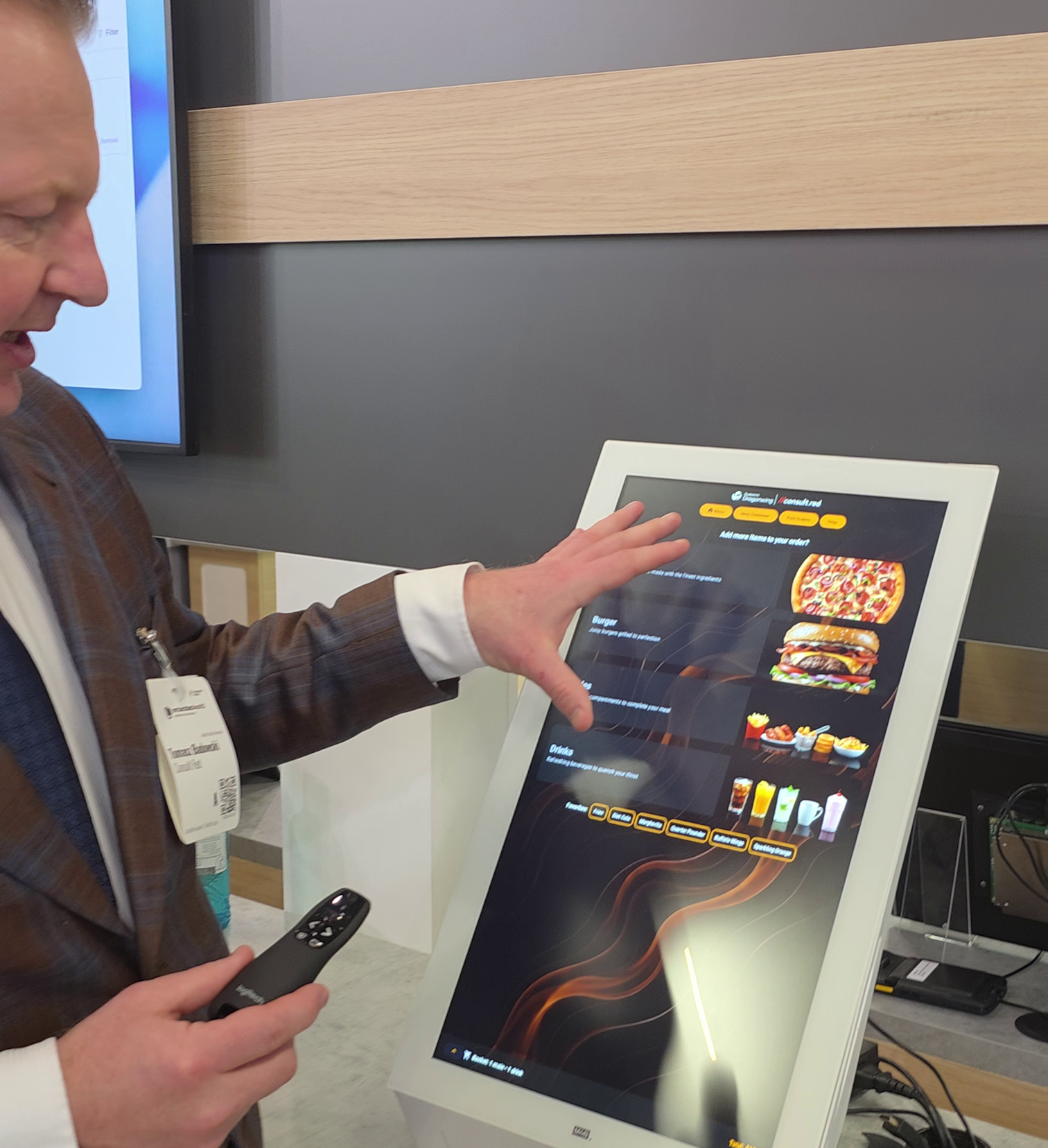
The following outcomes were observed during the live demonstration at Embedded World 2026. Formal latency, noisy-environment accuracy, power consumption, and sustained thermal metrics are planned following controlled benchmark testing.
-
Fully Offline Operation: The kiosk had no internet connection during the entire demonstration.
-
Android on Dragonwing IQ9: Android retail application ran through Consult Red's containerized environment on the Qualcomm Linux host.
-
Local AI Processing: Voice AI, speech recognition, and LLM inference ran entirely on the Dragonwing IQ-9075 processor.
-
Immediate UI Response: Voice commands triggered visible steps in the ordering flow with no perceptible delay.
-
Multi-Turn Interaction: The ordering flow included product selection, customization, basket review, checkout, and payment confirmation by voice.
-
Reduced Operating Cost: On-device inference eliminates per-transaction cloud processing fees.
-
Retail-Relevant Workflow: The demo matched a quick-service restaurant ordering scenario end to end.
Target Applications
The architecture validated on the Dragonwing IQ-9075 applies across retail environments where offline capability, low latency, and security-focused customer data handling are priorities:
-
Quick-service restaurant kiosks with voice-driven ordering
-
Self-service retail checkout terminals
-
Voice-assisted point-of-sale systems
-
Interactive digital signage with conversational AI
-
Drive-through ordering systems requiring reliable offline operation
-
Security-focused retail environments where customer data must stay on-device
-
Android-based kiosk modernization: bringing existing Android applications onto edge AI hardware
Conclusion
Consult Red's retail AI kiosk showcases how the Dragonwing IQ-9075 can support offline voice AI, LLM inferencing, and Android-based retail applications on a single edge platform. Existing Android kiosk applications can move onto Dragonwing IQ9 without rewriting the application stack. Voice AI and LLM inference can run locally, eliminating per-transaction cloud costs and network dependency. The Dragonwing IQ-9075 heterogeneous architecture is designed to provide the compute headroom, peripheral connectivity, and thermal profile required for production kiosk deployments. Consult Red supports the engineering services needed to integrate edge AI, helps enable Android on Dragonwing, and aims to accelerate time to market.
Learn More
- Consult Red: consultred.co.uk
- Qualcomm IQ-9075 EVK: The Qualcomm® IQ-9075 EVK for industrial-grade IoT
- Qualcomm Consult Red Embedded World 2026 Demo: https://www.youtube.com/watch?v=fAmO9jrnbHE
- Qualcomm AI Hub: Whisper-Base - Qualcomm AI Hub

