Knowing exactly where you are: How Qualcomm is redefining location technology


What you should know:
- Location technology, such as Global Navigation Satellite System (GNSS), is essential for modern connected devices, and Qualcomm Technologies is advancing it to deliver meter-level to centimeter-level accuracy.
- Qualcomm Meter-Level Positioning now achieves high accuracy without requiring a paid external correction service, making it accessible to more users and devices.
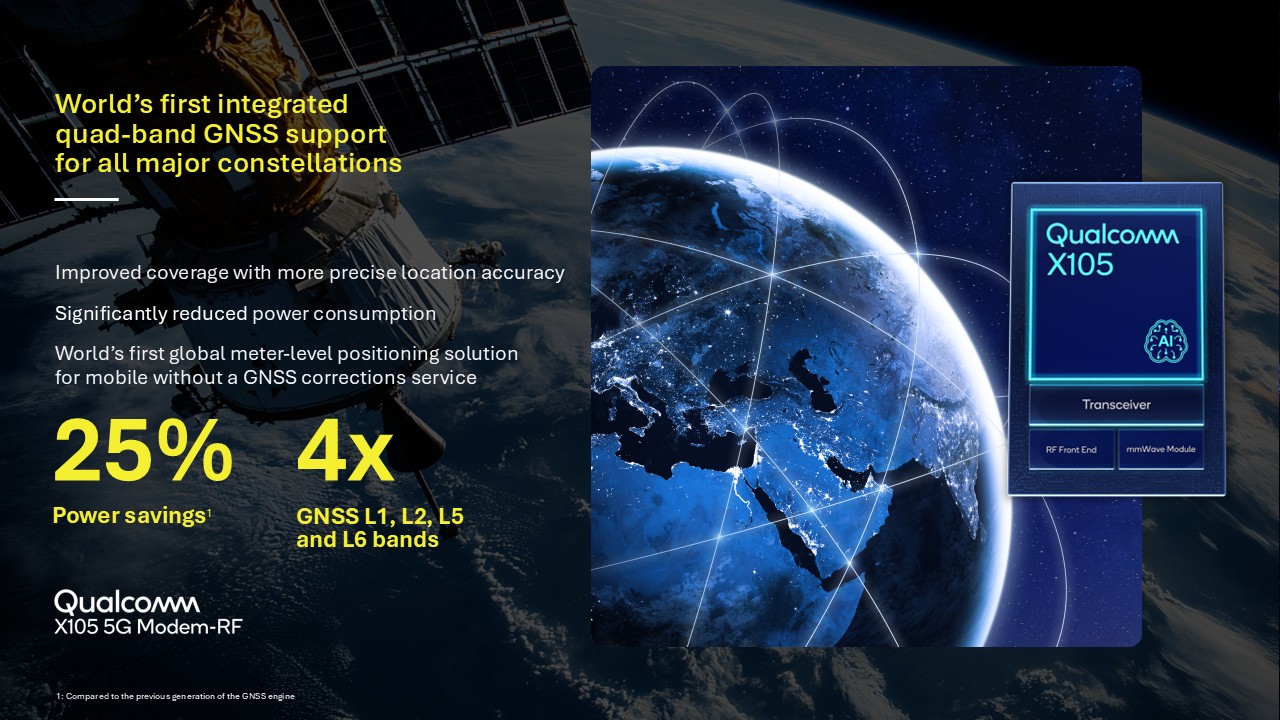
- The new Qualcomm X105 modem-RF chipset introduces Quad-Frequency GNSS, unlocking free decimeter to centimeter-level accuracy while reducing power consumption by 25% compared to the previous generation.
Whether you’re hailing a ride on a busy city street, navigating a drone over a field or relying on your car to get you safely home, one thing underpins it all: knowing exactly where you are. Location technology has quietly become one of the most essential capabilities in modern connected devices — and it’s evolving faster than most people realize.
Qualcomm Technologies has long been a leading provider of Global Navigation Satellite System (GNSS) solutions, and today we’re pushing the boundaries further than ever before. To us, GNSS is more than a standalone feature. It’s a system-level capability that’s designed alongside connectivity, compute and power management to enable precise, reliable location across billions of devices. From meter-level accuracy on your smartphone to centimeter-level precision for drones and autonomous vehicles — all with significantly reduced power consumption — the latest innovations from Qualcomm Technologies are setting a new standard for what location technology can do.
What is GNSS: Why multiple satellite systems matter
You’ve almost certainly heard of GPS, or Global Positioning System. It’s the satellite navigation system launched commercially by the United States in the early 1990s and for many years it was synonymous with the idea of positioning. But the satellite navigation landscape has grown considerably since then.
Today, other countries and regions have launched their own global or regional satellite constellations. Europe operates Galileo, Russia operates GLONASS, and China operates BeiDou. India has its NavIC system, and Japan operates QZSS. Taken together, all these systems fall under a common umbrella term: GNSS, which stands for Global Navigation Satellite System.
Why does having multiple satellite systems matter? Because when a device can receive signals from more than one constellation simultaneously, positioning becomes faster, more accurate and more reliable. Think of it like triangulating your location with more reference points — the more signals your device can hear, the more confident it can be about exactly where you are. This multi-constellation approach is especially critical in dense cities, remote regions or other real-world environments where reliability matters as much as raw accuracy.
GNSS didn’t start out as a consumer technology. In its early days, it was the domain of researchers, surveyors and engineers — people who needed to monitor shifts in the earth’s crust, plan the construction of roads and bridges, or manage large-scale precision agriculture. That changed in the early 2000s, when GNSS technology began making its way into mobile phones. Emergency services mandates in multiple countries required phones to be able to report their location, and that opened the floodgates. Suddenly, location awareness wasn’t just for experts — it was for everyone. App developers quickly embraced it, and today there are thousands of location-capable apps available across every major platform.
Location in your world: How devices use GNSS every day
GNSS is now woven into the fabric of daily life, powering experiences across a remarkable range of devices.
On your smartphone, GNSS helps you discover what’s nearby, navigate from one place to another, order a ride through your favorite app or make sure your food delivery lands at your door rather than your neighbor’s.
In your car, GNSS has become a cornerstone of telematics and infotainment systems — and increasingly, it plays a critical role in the push toward autonomous driving.
For professional and industrial users, GNSS powers everything from precision agriculture — where knowing the exact position of a tractor or planter can dramatically improve efficiency — to infrastructure monitoring and logistics.
The common thread across all of these applications is a growing demand for location data that is not just present, but precise.
Maximizing battery life: Why GNSS power efficiency matters as much as accuracy
Modern connected devices are marvels of engineering. At any given moment, your smartphone might be running 4G or 5G connectivity, Wi-Fi, Bluetooth and GNSS — all while simultaneously executing demanding computing tasks. Every one of these technologies draws on your battery, and managing power consumption is a constant engineering challenge.
GNSS is no exception. Location services that run continuously — tracking your route on a long drive, for example — can meaningfully drain a battery over time. That’s why Qualcomm Technologies has made power efficiency a key pillar of its location technology innovation. Our technologies incorporate GNSS as part of a broader power-optimized system that is designed to enable continuous, high-accuracy positioning without compromising battery life.
To put the impact in concrete terms: a 25% reduction in GNSS power consumption can translate to an additional 100 hours of GNSS tracking on a device with a 5,000 mAh battery. That’s not a marginal improvement — it’s the difference between a device that works for you throughout a long day (or a multi-day adventure) and one that leaves you scrambling for a charger.
Democratizing precision: Meter-level accuracy at no extra cost
One of the most exciting recent advances from Qualcomm Technologies is what we call Qualcomm Meter-Level Positioning.
Qualcomm Technologies first introduced Meter-Level Positioning in 2020. The original implementation used a combination of enhanced signal processing on Qualcomm Technologies’ chipsets and a paid external correction service to achieve significantly better accuracy under real-world conditions.
But here’s the key development: Qualcomm Technologies has now made it possible to achieve a similar level of accuracy without relying on a paid correction service. This is a significant shift. It removes a cost burden that previously fell on device manufacturers, network operators or end users, and it makes superior positioning accuracy accessible to a much broader audience.
What does this mean in the real world? Imagine you’re waiting for a ride-share pickup on a busy city street. With conventional GPS, your driver might not know which side of the street you’re on — and you might have to dodge traffic to reach them. With Qualcomm Meter-Level Positioning, the app can pinpoint your location with enough precision to eliminate that ambiguity. For the ride-share company, the same technology can track their entire fleet with greater accuracy, identifying which lane each vehicle is in and dispatching cars more efficiently — reducing both wait times and operational costs.
Quad-frequency GNSS: The next leap forward
To understand what Qualcomm Technologies is introducing with its latest Qualcomm X105 modem-RF chipset, it helps to know a little about how GNSS signals work.
Satellites broadcast their signals across different frequency bands. Most modern GNSS devices have long supported two of these: the L1 band (around 1,575 MHz) and the L5 band (around 1,176 MHz). Using both — what the industry calls Dual-Frequency GNSS, which Qualcomm Technologies introduced in 2018 — gives devices a meaningful accuracy advantage, especially in challenging environments like dense urban areas where signals can bounce off tall buildings.
In 2022, Qualcomm Technologies introduced Triple-Frequency (L1/L2/L5) support, adding the L2 band (around 1,227–1,246 MHz). Triple-frequency devices, when paired with sophisticated external correction services, can achieve positioning accuracy at the decimeter level — that’s roughly four inches — or even centimeter-level accuracy with a high-quality antenna. Remarkable, but it required subscribing to a paid correction service to unlock the full benefit.
Now, with the Qualcomm X105 modem-RF chipset, Qualcomm Technologies is introducing quadruple-frequency GNSS, adding support for the L6 band (around 1,278 MHz). L6 signals are already being broadcast by two constellations: Galileo (known as Galileo E6) and QZSS. What makes L6 remarkable is that it carries the same kind of high-accuracy correction data that previously required a paid service — but it is available free of charge to any device that can receive it.
In practical terms, this means that the decimeter-level and even centimeter-level accuracy that was once reserved for professional surveying equipment or premium subscription services is now accessible to a much wider range of devices — at no additional cost to the user.
What quad-frequency makes possible
The implications of quad-frequency GNSS reach across industries and device categories.
- Precision agriculture is one of the immediate beneficiaries. Tractors, planters and harvesters equipped with quad-frequency GNSS can operate with extraordinary precision — knowing not just which field they’re in, but exactly which row. This translates directly into reduced waste, lower input costs and higher yields.
- Drones — both consumer and industrial — can navigate more accurately and safely. Whether a drone is delivering a package, inspecting infrastructure, or capturing aerial footage, knowing its precise position matters enormously.
- Autonomous driving stands to gain as well. GNSS alone doesn’t make a car autonomous, but high-accuracy positioning is a foundational input to the sensor fusion systems that enable Level 2+ autonomy. With global coverage through Galileo E6 and QZSS L6 signals, this capability isn’t limited to specific geographies — it scales.
- And for everyday consumers, the benefits ripple through all the location-aware apps and services they already use — just with a level of precision that was previously out of reach. Across these use cases, the common denominator is location data that is precise, reliable and efficient enough to run continuously.
And at Qualcomm Technologies, we know that delivering this at scale requires tight integration across silicon, software and connectivity.
Looking ahead: Location technology without limits
Qualcomm Technologies has spent decades pioneering in GNSS technology, and the innovations described here represent the next chapter in that story. By delivering breakthrough accuracy improvements without added cost or complexity, these advances reflect a deep commitment to making location technology work better for everyone.
To summarize what’s new:
- Meter-Level Positioning without a correction service — high accuracy, now accessible to more devices and users without additional subscription costs.
- 25% reduction in GNSS power consumption compared to the previous generation — translating to up to 100 additional hours of location tracking on a typical device.
- Quad-frequency GNSS on the Qualcomm X105 modem-RF chipset — unlocking decimeter to centimeter-level accuracy for free, using correction signals already broadcast by existing satellite constellations.
Looking ahead, there is no doubt that these enhancements in GNSS accuracy and power efficiency open the door to entirely new use cases across devices and device categories. As the world becomes more connected — and as devices become smarter, more autonomous, and more deeply integrated into the fabric of daily life — knowing precisely where you are will only matter more. Location technology will shift from a background utility to a core input. Qualcomm Technologies is committed to making sure the technology is ready when the world needs it by enabling devices to understand not just where they are, but how to act on that information efficiently, securely and at global scale.
Go Deeper
Does continuous high-accuracy positioning compromise device battery life?
We engineered our location technologies as part of a broader power-optimized system, achieving a 25% reduction in GNSS power consumption compared to the previous generation. This breakthrough can translate to an additional 100 hours of tracking on a typical device, enabling continuous precision without draining your battery.
What makes quad-frequency GNSS a meaningful advancement beyond what triple-frequency already delivered?
With our Triple-Frequency chipsets, decimeter to centimeter-level accuracy was achievable — but only when paired with sophisticated external correction services. The Qualcomm X105 modem-RF chipset adds support for the L6 band, which carries comparable correction data already broadcast by Galileo and QZSS constellations, bringing that same level of precision to a far wider range of devices.

