Resilient: From curious in Cameroon to three-time Qualcomm patent holder [+video]
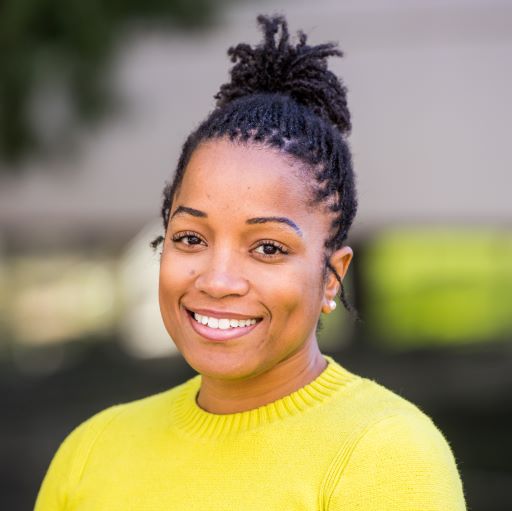
From curious in Cameroon to three-time Qualcomm patent holder
Feb 09, 2023 | 15:29
To celebrate Black History Month, we’re diving into this year’s theme — resilience — by bringing together three-time patent-granted Qualcomm Technologies, Inc. engineer, Dr. Kelly Tchambake, and Diversity, Equity, and Inclusion manager, Tyrene Essell, to inform and inspire.
And this is a conversation you won’t want to miss: This astute inventor is putting her dreams, inspirations, obstacles, collaborations, resources, culture, and more on the table for you.
Tyrene Essell (TE): Tell us a little bit about yourself; Where did you grow up, and what inspired your interest in engineering?
Dr. Kelly Tchambake (KT): I was born and raised in Cameroon. I have three siblings, and my mother worked in a shipping company in Douala, Cameroon, Central Africa, where we lived. My father was a mechanical engineer who had a lot of ideas and created three startups back in Cameroon. And he had a real passion for technology, he used his phone a lot — like a lot. And he always mentioned about the heat he was experiencing from his phone. This motivated me to understand how mobile phones work, but also to understand and try to find a solution to the heating issue he had with his phone. Ultimately, this inspired me to become an engineer.
After graduating in Cameroon, I pursued undergraduate and my graduate studies, respectively, in Toulouse and Bordeaux. Then I attended Texas Tech University for a research internship. After serving as an application engineer intern at Broadcom Inc. in the San Francisco Bay area, I went to France for my PhD at Télécom Paris.
This is when things came full circle: My PhD subject was a new circuit to improve the efficiency of power amplifiers. Power amplifier is one of the most power-hungry components in our mobile phones. And this is one of the main heat sources that you may have experienced in your phone. And this is also — in part — why, after my PhD, I ultimately landed at Qualcomm in Cambridge.

About Qualcomm inventor, Dr. Kelly Tchambake
TE: Can we talk about how that was a lot? Black History Month’s theme is resilience, and you are an inspiration to this value. You’ve worked at Qualcomm for five years that you've worked on radio frequency (RF) and analog design teams in Cambridge, England. Tell us about your work. What keeps you inspired and why Qualcomm?
KT: I work as an engineer on the design team at Qualcomm, focusing on voice and music applications. We work on state-of-the-art circuits and chips for products like headphones. My work is mainly to design blocks of the Bluetooth radio. Let's say for example, in an ear bud, I design the Bluetooth subblocks inside this radio, which is pretty cool, to be honest. I particularly like the noise cancellation feature. So, we work on a lot of a lot of things.
At Qualcomm I really like and am inspired by, firstly, environment, which is to be honest, really good. People are open and my colleagues are very, very talented and are very human, they understand yourself... it's great. Really, I really like my colleagues, to be honest.
TE: Wow, that's great. It's important to like your colleagues, especially because we all spend so much time together. Qualcomm really is a special place. And I do think there are so many teams across the company, that are just super supportive, very innovative, and great listeners. And it seems like you've been able to find all three of those things within your teammates.


TE: I'd love to hear more about your journey as an inventor. What advice would you give to aspiring women and underrepresented minority inventors.
KT: When I interviewed at Qualcomm, I was inspired and impressed to see my colleagues’ ideas on the Qualcomm patent wall, knowing the end-user products have a big impact in people's life. After joining the company, I started to work on a new analog-to-digital converter implementation, and after working several hours with two colleagues on this idea, we realized we had a new architecture that has not been implemented. That’s when we knew it was time to start our patent application. We applied for a patent and a year after the patent was granted. So that's how I arrived at my first patent.
TE: What advice do you have for other women investors or inventor-hopefuls?
KT: To have a purpose. And to have a problem you would like to solve — this will be your drive. Plus, come up with new ideas: It's ideal to have a problem to solve because you want to impact people's lives.
Number two is to be curious: be resilient and persistent. This is important when you have doubts or need to overcome setbacks and challenges.
And number three — the most important one — is to reflect. Reflect on mistakes to avoid them in the future. But also reflect on successes to be more efficient the next time you face the same issue.
TE: Being resilient, being curious, and then also learning ways to be more efficient: I love that. It’s reflective, but it's also forward thinking. How would you explain to someone how your patents and inventions help them enjoy their everyday lives? The work you do is very cool, but at the end of the day, does touch people's everyday lives?
KT: My patents are on new architectures of analog to digital converters ADC, a device which converts an analog signal, which is sometimes a sine wave into a digital signal, which is a series of zeros and ones. The purpose of converting the signal is to process the data and process the signal with our phone... In our phones we have, for example, Bluetooth, Wi-Fi, and radios. In each of these radios, we have ADC, so we use ADCs a lot.
Nowadays we want to have smaller devices and devices that do not consume a lot of power. My invention allows people with earbuds, for example, to have a better sound quality, and to use a smaller device, which means that the buds can be even smaller.
TE: I know I love the smaller earbuds, and it just makes it seamless, whether I'm walking or exercising, and most of the things that you all are thinking about the factors that you're considering when you're working on this technology. So, I appreciate the work that you're doing.

TE: Let's talk more about Qualcomm and the culture here, and how it's supported your ability to invent and create new technologies.
KT: Qualcomm truly has a culture of innovation — purposeful innovation, to ease people's life. We are encouraged to innovate and to express our ideas. And we have a lot of resources to find new ideas: we can go to conferences, we have internal conferences, and we have trainings. We also have a lot of resources to demystify the patent process, because patenting can be complicated if you don't know how it works. There are also workshops, formal mentorships, and role models, all with support from the management.
In addition to that, we have a diverse team. For example, in my team, we have seven people from five different countries. So, when for example, someone comes up with a challenge, you can end up with at least three different ways to solve the problem. This diversity of culture encourages innovation.
In addition, we value collaboration. We're encouraged to work with different teams; for example, we work with teams, other teams in Cambridge, but we also work with people in different countries — in the United States, France, Germany, India, and Taiwan. This inspires brainstorming to find new ideas. We are encouraged to express our ideas without any judgment. And that's excellent for innovation.
TE: This speaks to Qualcomm's value of diversity, equity, and inclusion, and how inclusivity really fosters innovation and that collaborative community that is so central to Qualcomm's culture. Thank you for sharing that. I want you meet your teammates, because they sound amazing. Is there anything else you’d like to share about your resilience and what continues to keep you motivated?
KT: I have a personal story about resilience: When I was in engineering school, we had mock interviews and identified real jobs we’d like to apply for. Weirdly, I went with two offers: one from Broadcom and the other from Qualcomm. I was dreaming of working for Qualcomm even back then.
This goes to show that, when you have your dream, do not give up on it. Keep pushing, keep chasing, keep working hard, and definitely, definitely there's only one way to get success.
TE: Kelly, I appreciate you. Thank you for you sharing your story. It’s important for other inventors to hear it, especially women and underrepresented minority inventors. You’re keeping us all inspired.
This interview was transcribed and edited for clarity.

