
Workplace health and safety is one of our highest priorities.
At Qualcomm, we integrate environment, health and safety (EHS) principles and practices into our everyday operations, ensuring a safe and healthy workplace for our employees, contractors, and anyone we do business with. Our EHS policy highlights our commitment to proactively manage workplace health and safety risks while continually improving our established management system. We maintain compliance with applicable legal and other requirements, regularly monitor and improve EHS performance, mitigate hazards and risks, and incorporate industry best practices. The policy also provides a framework for setting and reviewing EHS objectives.
Our EHS Management system brings our policy to life.
Our EHS Code of practice serves as the foundation of our EHS management system and reinforces our Code of Business Conduct (CoBC) and EHS policy. It outlines a set of globally applicable business practices and assurance processes that guide how we manage our operations. These practices help to ensure a consistent approach to occupational health and safety, environmental protection, community health and safety, and regulatory compliance, while promoting continuous improvement.
Our EHS management system is structured around internationally recognized standards: International Organization for Standardization (ISO) standards 14001 and 45001 and serves to:
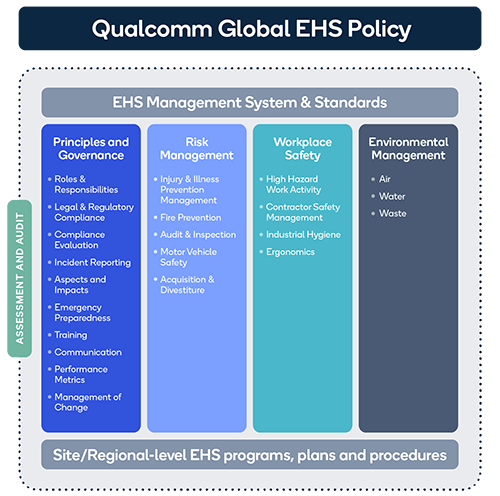
- Core EHS principles: Outline the minimum elements that must be implemented at Qualcomm sites and defines roles and responsibilities.
- Risk management: Ensure that Qualcomm business and job functions conducted in the workplace protect employees, contractors, visitors, and temporary employees by identifying and controlling occupational hazards, as well as managing EHS business risks.
- Workplace safety: Ascertain that Qualcomm sites implement programs in key areas of employee occupational health and safety.
- Environmental management: Establish directives for Qualcomm sites to meet or exceed applicable regulations and standards related to our environmental footprint, including impacts to air, water, chemical waste and energy use.
Qualcomm requires all its worldwide offices, labs, and manufacturing sites to apply the EHS Code of Practice to avoid, mitigate and manage health and safety risks. The EHS Code of Practice is periodically reviewed and updated to maintain alignment with industry best practice and ensure continuous improvement.
We conduct employee health & safety assessments across our headquarters, all our R&D centers, engineering labs, and distribution centers. We have a multiple tier approach to health and safety assessment. We conduct health and safety self-assessments in our laboratory areas using an internal scorecard as part of our annual compliance assurance process. Engineering lab representatives and local EHS engineers perform periodic spot checks and inspections to assess compliance within the lab environment. Regular internal EHS gap assessments evaluate program effectiveness, and third-party external audits verify compliance with country-specific regulatory requirements. With this approach, all our operational sites are in scope for and receive health and safety assessments.
Workplace safety targets
While the goal is no harm, our current annual global targets are to achieve a Lost Time Incident Rate (LTIR) of less than 0.50 and a Total Recordable Incident Rate (TRIR) of less than 0.60. Together with periodic inspections, audits, and management reviews, we execute a complete EHS management and assurance process to ensure we fully protect our employees, contractors, and others while providing a safe and healthy working environment. Additional EHS-related information and performance indicators are published in our annual Corporate Responsibility Report.

Certifications
At Qualcomm, we primarily utilize a fabless production model, which means that we do not own or operate foundries for the production of silicon wafers from which our integrated circuits are made.
That said, we have three internal manufacturing facilities which are primarily used to manufacture certain RFFE modules and RF filter products Radio Frequency Front End (RFFE) modules and Radio Frequency (RF) filter products. These sites are formally certified by the internationally recognized ISO 45001 standard on occupational health and safety management, as well as ISO 14001 for Environmental Management and ISO 50001 for energy management. Compliance with these international standards is regularly audited and verified by external auditors each year. For more information on certifications, please see our RF360 webpage.


