Wi-Fi 7: Unlocking next-level performance in gaming, XR, enterprise applications, and more

For Wi-Fi technology, 2023 will undoubtedly be the year of Wi-Fi 7 — thanks to multiple new devices based on the latest version of the Wi-Fi standard entering the market. The three main areas of improvement are faster connections through wider channel bandwidth and advanced modulation, adaptive connections with higher noise immunity and better spectrum utilization, and the ability to create multiple connections in a flexible manner. These improvements help to experience a wire-like performance through a wireless connection.

The combination of lower latency, higher speed, and increased capacity in Wi-Fi 7 will be at the heart of advanced use cases in gaming, remote docking, extended reality (XR), metaverse, edge compute, and more. Additionally, mesh routers — specifically, the Qualcomm Multi-Link Mesh — can greatly benefit from Wi-Fi 7 due to more flexible configurations of backhaul and fronthaul wireless links, vastly improving coverage of homes with high-speed Wi-Fi. These benefits are expected to grow the Wi-Fi 7 devices market with a CAGR of approximately 87% from now to 2027.

Multi-link technology lowers latency and can improve throughput
Today, Access Points (APs) often support up to three bands: the legacy 2.4 GHz low band and two in the 5 and the 6 GHz high bands. Wi-Fi 7 enables multiple links in these bands to be combined into a single broader channel or to seamlessly alternate between two channels through its Multi-Link capability. The simultaneous Multi-Link operation aggregates two links in the same or different bands into one logic entity with the combined throughput of the two links, creating the fastest possible Wi-Fi link. As it can use each channel as they become available, it avoids congestion and lowers latency. Compared with today’s Dual Band Simultaneous (DBS) feature that uses two separate streams with separate IP addresses, the new Wi-Fi 7 Multi-Link aggregation can create a faster link with a single IP address. This feature is especially interesting for online gaming, since few servers support multi-IP streams for gaming today.
Alternating Multi-Link uses the first available channel for each data transfer to avoid congestion and lower latency as depicted in figure four. This Multi-Link operation is possible with a single Wi-Fi radio, with the ability to listen on two channels simultaneously and to transmit on the first available. As it is still a single radio, it can only use one channel to transmit or receive at a time, that transfer must complete before another can start on either channel.

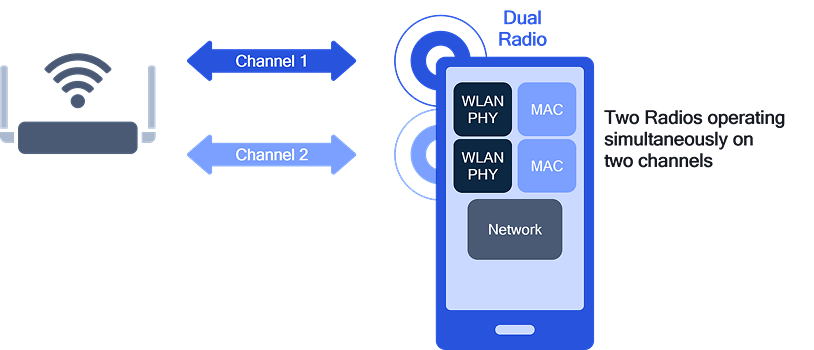
Since simultaneous Multi-Link capable devices contain two independent Wi-Fi radios, they can establish simultaneous links to different devices as shown in figure five. This can eliminate noticeable lag and jitter for state-of-the-art gaming, remote docking, and XR applications.

HBS ML – Expansion of wide-channel bandwidth for all regions
Wi-Fi 7 introduces 320 MHz wide channels in the 6 GHz spectrum, thus doubling the channel capacity compared to Wi-Fi 6/6E and significantly increasing data speeds up to 5.8 Gbps for a single channel. Since contiguous 320MHz channels are not available everywhere, due to no 6 GHz, overlapping interferers, or APs configured for lower bandwidth, Qualcomm Technologies, Inc. created High Band Simultaneous Multi-Link (HBS ML), focusing Multi-Link technology onto the high-bands. HBS ML can combine channels in the 5 GHz low- and high-band or the 6 GHz band, and boost throughput by up to 100 percent compared to Wi-Fi 6/6E — even in regions with just 5 GHz bands available — resulting in a wire-like performance.

The resulting HBS ML throughput reaches up to 4.3 Gbps in geolocations with 160 MHz plus 80 MHz channels and up to 5.8 Gbps in regions offering 160 MHz + 160 MHz channels if combined with 4k QAM modulation. Besides regulatory limitations, managed APs in enterprises and public networks typically don’t offer 320 MHz wide channels and instead distribute the available spectrum across multiple APs to better manage the number of connected devices and the Quality of Service provided to each device. With High Band Simultaneous Multi-Link, a client can aggregate across those narrower channels to boost speeds beyond Wi-Fi 6 and reap in the related latency benefits in those often-congested networks.
HBS ML is freeing up the 2.4 GHz spectrum
By moving high-throughput and latency critical application into the high bands, Qualcomm’s HBS ML technology also improves the performance within the 2.4 GHz band. Numerous IoT devices rely on the legacy 2.4 GHz band for connectivity at the outer edge of the AP’s range, with their functionality and user experience not being agnostic to latency or lower throughput. Examples for typical 2.4 GHz spectrum connected devices are depicted in figure seven.

Enabling exciting new experiences and use cases with Wi-Fi 7
Wi-Fi 7, apart from elevating the performance of applications that most of us use today, will also enable new experiences such as latency sensitive XR applications and immersive, realistic XR experiences requiring exceptionally high-quality video with very high refresh rates — very high speeds and low latency — to prevent noticeable lag, which would degrade realistic impressions of the virtual world. Remote docking applications benefit from the high-throughput, low-latency multi-device connectivity feature, enabling connections to, for example, high-resolution screens and other peripheral devices while simultaneously operating a link to an AP.
Further, the edge cloud is a fundamental component of enterprise digital transformation. With Wi-Fi 7 being the last hop for many enterprise use cases, designed to provide low latency, required individual device throughput to numerous simultaneously connected clients will become vital for many business-critical applications. Venues and publicly available Wi-Fi networks greatly benefit from throughput and high-end Wi-Fi 7 access points that support over 500 simultaneous users per channel, resulting in over 2,000 users per AP if required for concert goers, sports fans, and people on the move.

