CES 2023: Qualcomm Technologies collaborates with transportation stakeholders for safer, more sustainable roadways


Today’s cameras, sensors, and driver assistance features are making modern vehicles smarter and safer than ever before. Yet, according to the World Health Organization, nearly 1.3 million people are killed and another 50 million are injured in vehicle crashes around the globe every year.1 Many of these deaths can be prevented, and for the transportation industry, a great next step is deploying cellular-vehicle-to-everything (C-V2X).
A wireless technology that allows vehicles to communicate directly with each other (V2V), with roadside infrastructure (V2I) and potentially with pedestrians (V2P), C-V2X supports direct information sharing to enhance safety for all road users. According to U.S. National Highway Traffic Safety Administration (NHTSA), safety applications supported by V2V and V2I could eliminate or mitigate the severity of up to 80 percent of non-driver impaired multi-vehicle crashes. 2
It plays a critical role in safety because it allows the vehicle to see more than the driver can see. Far more robust than today’s sensors that merely keep vehicles safe in their immediate surroundings, C-V2X connects vehicles, roadside infrastructure, and pedestrians outside of each other’s line-of-sight so they can share safety and traffic information. And with complementary 5G and cloud connectivity, C-V2X extends safety alerts to nearby vehicles and infrastructure to support new services that could help further decrease road incidents and improve trip planning, drive mode choices, and traffic efficiency.
Connected infrastructure can benefit others in transportation as well. With electric vehicles (EV) expected to grow to approximately 60 percent of total production by 20273, intelligently connected EV charging infrastructure will become fundamental. Connecting charging units enhances user convenience, while allowing providers to update units remotely and support vehicle-to-grid integration to help balance energy flowing between vehicles, charging stations, and the electric grid.
Many in transportation are eager to deploy these solutions that will enhance safety and sustainability, and Qualcomm Technologies is proud to collaborate with the following leaders to bring next generation transportation experiences to life.
Enhanced safety today
Deploying C-V2X has the potential to improve road safety immediately. Sharing safety information directly in real-time could help to reduce road incidents and save lives. For example, a red-light violation warning that alerts a driver to take action instead of running the light could help prevent the seven fatalities and more than 1,000 injuries that happen at signalized intersections across the U.S. every day.4
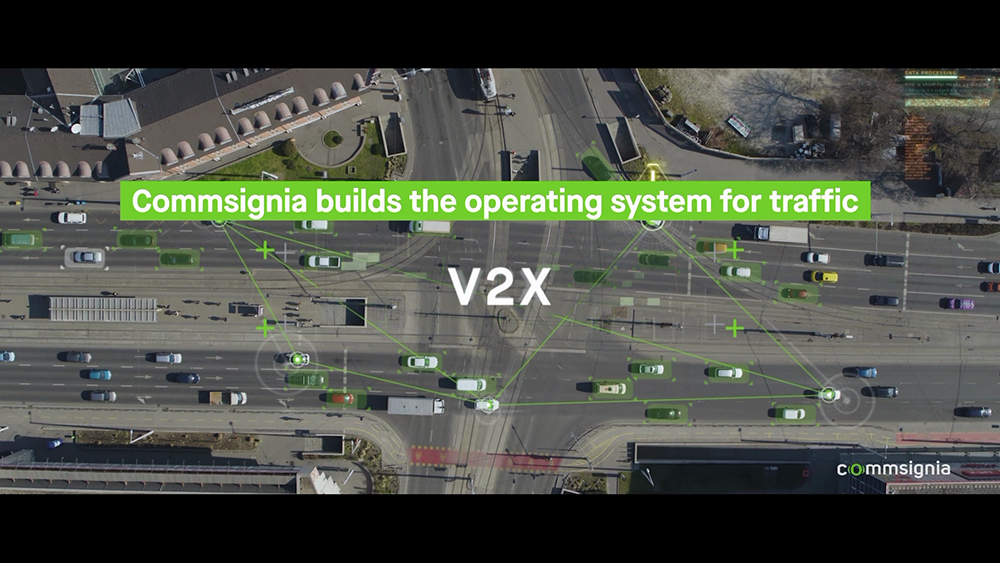
We worked with Commsignia to show the immediate impact of C-V2X on the streets of Las Vegas, demonstrating how drivers and transportation agencies benefit when information is exchanged between vehicles and infrastructure in real-time.

Protecting vulnerable road users
Vulnerable road users (VRUs) such as pedestrians, cyclists, and the growing number people using micro-mobility options such as e-bikes and scooters can benefit from C-V2X, making vehicles and other road users aware of their presence.
Spoke, a mobility platform for safety, connectivity, and rich rider experiences, has integrated their C-V2X solution to connect micro-mobility users such as cyclists and scooter riders.
At CES 2023, we demonstrated this using a Trek bike featuring the Spoke mobility solution.

Intelligently connected infrastructure
When complemented by 5G networks and cloud connectivity, C-V2X makes entire transportation systems smarter and more efficient. Sharing information over cellular networks (V2N) supports a broad range of mobility applications such as smart parking, mapping services, and fleet management.
Connecting a cloud-based system to the network allows road operators to use actionable intelligence from aggregated C-V2X data to support transportation management services. These added layers of connectivity allow road operators to monitor and dynamically conduct operations based on current conditions, facilitating broader awareness for safety alerts, and more efficient traffic flow.
Qualcomm is working with the City of Bellevue, T-Mobile, and Applied Information to demonstrate how a cloud-connected midblock pedestrian crossing installation can be augmented with connectivity to make pedestrians more noticeable to all vehicles in the area. Equipped with a roadside unit (RSU), the crosswalk sends a direct C-V2X alert to approaching vehicles when pedestrians are nearby. An alert is also sent to the network and the cloud to let other vehicles in the area know that pedestrians are present.
“We chose Qualcomm for our upcoming C-V2X collaboration focused on pedestrian crossing safety. The City of Bellevue embraces these fast-evolving technologies in support of its Safe System approach to Vision Zero. The digital infrastructure and connected services solutions from Qualcomm will help Bellevue move towards its goal of zero fatalities and serious injury crashes on city streets by 2030.”
– Franz Loewenherz, Mobility Planning and Solutions Manager for the city of Bellevue, WA
“C-V2X communications are a critical part of the transportation fabric because it allows everything to be connected, including infrastructure, school buses, emergency vehicles and more. We are excited to collaborate with Qualcomm to advance road safety and potentially reduce the tens of thousands of roadway deaths and untold injuries that occur each year.”
– Bryan Mulligan, president of Applied Information

Connected EV charging
In addition to supporting a multitude of safety applications, connected infrastructure also brings added convenience for consumers and service providers. For example, EV charging stations with cellular connectivity support user authentication for convenient user charging and payment, while allowing service providers to deliver over-the-air software updates and monitor, diagnose, and troubleshoot stations remotely for minimal downtime.
The majority of EVs and charging stations in the U.S. are equipped with Powerline Communication (PLC) technology, enabling communication between the vehicle and charging station to support smart charging applications. In the future, users can also enjoy streaming multimedia, gaming, and other entertainment while charging with data rates up to 200Mbps using HomePlug AV (HPAV). The Combined Charging System (CCS) leveraging PLC HPGP communication also allows units to feed electricity back into the energy grid when needed, helping to balance demand for power as more EVs enter the market.
Qualcomm and BTC Power are collaborating to bring connected charging stations to their large install base of customers, including charge point operators, oil and gas, convenience stores, retail center, fleets, and more.
Localizing safer, more sustainable transportation
Today’s technology can help make roads safer, not just for the next generation, but now.
And financial support for transportation safety advancements is available too. The Infrastructure Investment and Jobs Act (IIJA) signed into law in November 2021 authorizes $1.2 trillion for transportation and infrastructure spending with $550 billion going toward new investments and programs. More information is available through the US Department of Transportation, including a full list of funding opportunities with anticipated dates into 2023 to provide more visibility for industry stakeholders.
Now is the time to act on road safety, traffic efficiency, and support the transition to electric vehicles. We’re excited about the collaborations that Qualcomm has enabled so far, and we invite you to join us to make transportation safer and more sustainable today, and for many generations to come.
1. United Nations to act for global road safety
2. https://one.nhtsa.gov/About-NHTSA/Press-Releases/ci.nhtsa_v2v_proposed_rule_12132016.print
3. IHS Semiconductor Market Tracker
4. Support study for impact assessment of cooperative intelligent transport systems

