
On this Page
Introduction
Dataset format details
Dataset organization details
Dataset generation details
References
Community
Get the Qualcomm® newsletter straight to your inbox.
The Wireless Indoor Simulations datasets collection contains four different datasets. The purpose of the datasets is to enable a better understanding of the interplay between the propagation environment (e.g., materials, geometry) and corresponding channel effects (e.g., delay, receive power). The four datasets vary in the number of simulated wireless channels, the spatial distribution of the transmitters and receiver, and the number and diversity of the floor layouts. While WiPTR and Wi3R are more diverse in the number of floor ...
Here are additional details about each dataset
| Dataset | Floorplan source | Simulation tool | Layout Size | # rooms | # scenes | channels per scene |
|---|---|---|---|---|---|---|
| WiPTR | ProcTHOR [4] | Wireless InSite [3] | Up to 23x35x5m | 1-10 | 12K | ~500 |
| Wi3R | Synthetically generated | Wireless InSite [3] | 10x5x3m | 3 | 5K | 1K |
| Wi3Rooms | Synthetically generated | PyLayers [1] | 10x5x3m | 3 | 100 | ~96K |
| WiIndoor | RPLAN [2]Wireless InSite [3] | Wireless InSite [3] | 10x10x3m | 4-8 | 3 | ~123K |
Dataset details for Wi3R and WiPTR
The zip files contain different splits of the datasets in separate directories. Each split contains a hdf5 file which stores the simulation input and output, i.e., the simulated wireless channels. For Wi3R, the `objs/` directories contain the 3D meshes of each floor layout as JSON files named by the floor ids. For WiPTR, the `dae_noobjs_pieces/room_<floor_id>` subdirectories contain the 3D meshes as DAE files for separate object groups in the complete layout.
For more information, please check Section 4 and Appendix D of our ICLR 2025 paper. (https://arxiv.org/pdf/2406.14995). Additional details, for example about the h5 format details (which is different to Wi3rooms and WiIndoor), can be found on our github repository: https://github.com/Qualcomm-AI-research/WiInSim
Dataset details for Wi3rooms and WiIndoor
The simulations are stored as HDF5 files (which can be conveniently read using e.g., h5py). The simulations were run over all combinations of random discrete choices of transmit (10-15 locations) and receive (~2K) spatial locations in each floor layout. Each HDF5 file contains the following tensors:
‘channels’ (F, T, 1, R, D=8, K)-shaped tensor
containing channel simulations. For instance, channels[floor_idx, tx_idx, 0, rx_idx] fetches a (D=8, K)-dim channel for a combination of floor layout and transmit-receive link. The channel is represented as a set of D=8 attributes (e.g., gains, time-of-flight; more details below) for each of the K paths in the impulse response.
‘tx’ (F, T, 3)
3-dim spatial coordinates of transmit device (in meters)
‘rx’ (F, T, 1, R, 3)
3-dim spatial coordinates of receive device (in meters)
‘interactions’ (F, T, 1, R, K, I, 4)
geometric traversal data of the path. interactions[floor_idx, tx_idx, 0, rx_idx, path_idx] fetches a (I, 4)-dim tensor containing a sequence of I interactions the path (i.e., the ray) undergoes between the transmitter and receiver. See below for more details.
‘floor_idx’ (F)
index of the floor. The floor-plan geometry can be fetched as e.g., ‘.obj’. In case of Wi3Rooms, this index corresponds to the numpy random seed that was used to randomly generate the floor plan. The sequence in this case is not continuous, since some seeds generated layouts that led to simulation errors..
Where:
F
#environments
T
#tx locations
R
#rx locations
K
#paths
D
8-dim attributes per path. The 8-dim correspond to:
- 0: magnitude of complex gain (in dB)
- 1: phase of complex gain (in radians)
- 2: time of flight (in ns)
- (3, 4): departure angles (azimuth and elevation, in radians)
- (5, 6): arrival angles (azimuth and elevation, in radians)
- 7: validity (either 0/1). 1 indicates regular element, 0 for padding element (we have this since we have variable of paths in each channel)
I
#interactions.
Each interaction of the ray with some surface is further annotated with a 4-dim vector containing the interaction type and spatial co-ordinate where the ray is incident:
- 0: interaction type, which can one of the following discrete values: 0 = either tx/rx location; 1 = diffraction; 2 = reflection; 3 = transmission; 4 = reflection with ceiling; 5 = reflection with floor
- (1, 2, 3): 3-dim xyz spatial co-ordinate (in meters) where the ray is incident
Dataset organization details
The (uncompressed) simulation HDF5 files following the naming convention:
<DS_NAME>-<SPLIT_NAME>-dataset_<PSUBSET_NUM>.h5
where:
DS_NAMEis one of {Wi3Rooms, WiIndoor}- SPLIT_NAME is one of {train, test1-checkerboard, test2-genz, test3-gendiag}
- SUBSET_NUM is a subset of the dataset split, containing all necessary simulations for a subset of the floor layouts (at most 50 layouts in each subset). These subsets were primarily created to keep each file to a manageable size (<1G).
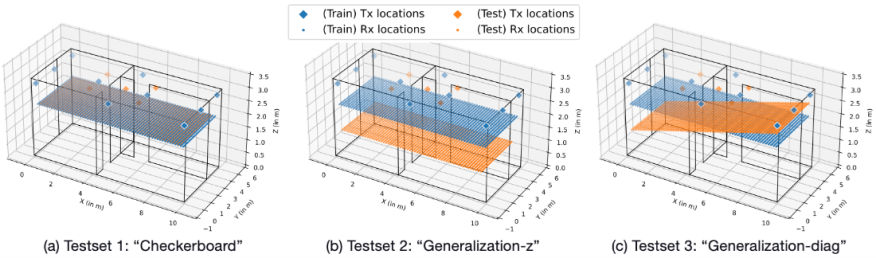
SPLIT_NAME: Now we provide more details on the “split”. Each dataset (Wi3Rooms/WiIndoor) is split into 1 training set and 3x test sets (referred to as “checkerboard”, “generalization-z”, and “generalization-diag” in the paper). See image below where the train set (blue markers; common to all sub-figures) and 3x test sets (orange markers) are shown for the 0th-index floor in the Wi3Rooms data, as a result of varying the tx/rx locations.
Additional details on the 4x sets:
Train set
We collect channels by sampling transmitter (‘Tx’) from approx. 10 locations (XY plane at an elevation of 2.8m) and similarly, receiver (`Rx') from 60⨉30 locations (but with elevation of 2m).
Checkerboard
Where train and test Rx locations form a checkerboard pattern (alongside training locations) on the same XY plane at 2m elevation
Generalization-z
Where we move the test Rx locations from checkerboard to a novel elevation (z=1.0m for wi3Rooms and z=2.5m for wiIndoor); and
Generalization-z
Where we sample test Rx locations on a diagonal XYZ plane.
Dataset generation details
Generation details common to both Wi3Rooms and WiIndoor: All simulations were carried-out with a 3.5 GHz carrier frequency. Both transmit and receive wireless devices were configured with an omni-directional antenna beam pattern with a single element.
Wi3Rooms-specific details
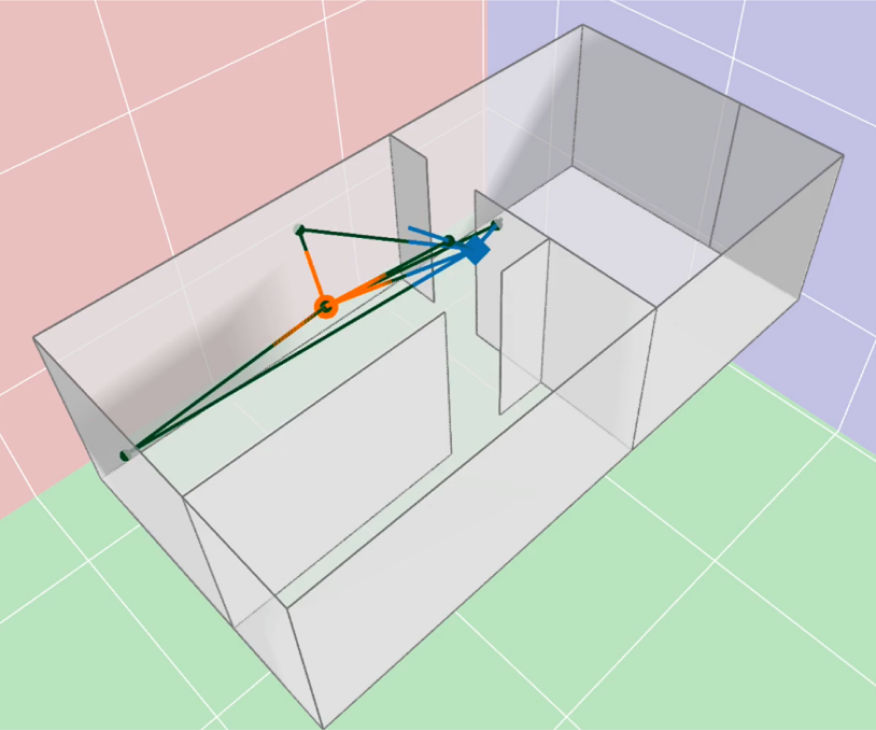
- Layouts: Each floor plan spans an area of 10⨉5⨉3m. We also include the .lay files that contains the information (geometry, materials) that can be provided to pylayers to re-generate the simulations.
- Materials: The ceiling and floors are set to reinforced concrete and remaining walls are set to brick.
WiIndoor-specific details
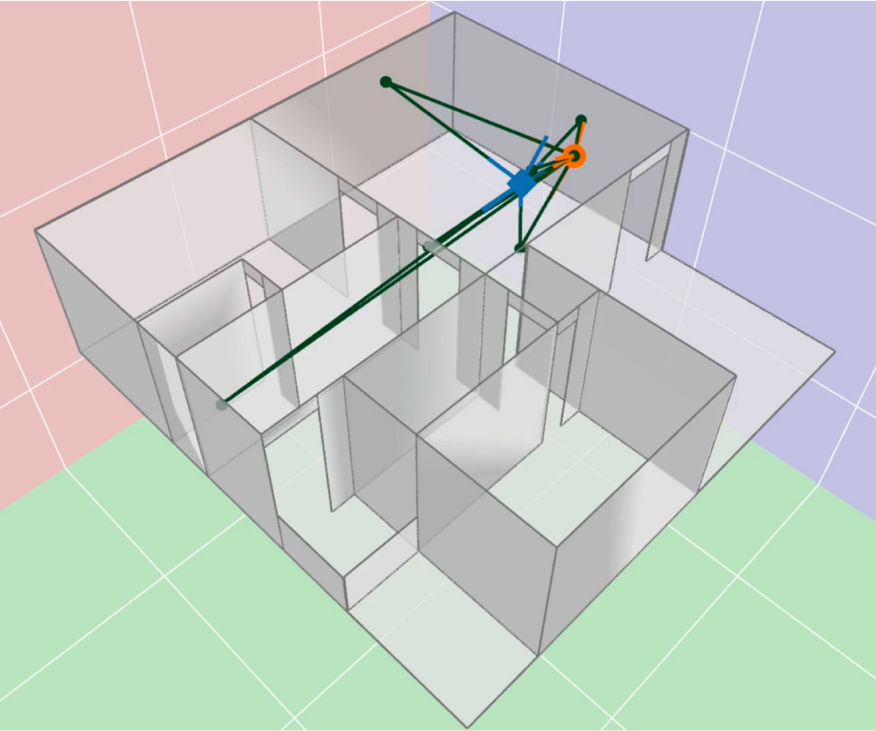
- Layouts: Each floor plan spans 10⨉10⨉3m. The indices of the floor plan (1-3) correspond to the layout from the RPLAN dataset.
- Materials: Since RPLAN does not include material information, we manually specify them. Layered dielectric with two layers separated by free space of 89cm is chosen for all inner walls and the outer walls were made of thicker materials of concrete. Doors were created using free space except the balcony door which was created using glass with a small thickness. The balcony walls were laid out using brick walls.
Dataset license
The WiPTR, Wi3Rooms & WiIndoor datasets are available for research purposes.
Dataset Citation Instructions
For WiPTR and Wi3R, please cite:
@inproceedings{
hehn2025wigatr,
title={Differentiable and Learnable Wireless Simulation with Geometric Transformers},
author={Thomas Hehn and Markus Peschl and Tribhuvanesh Orekondy and Arash Behboodi and Johann Brehmer},
booktitle={The Thirteenth International Conference on Learning Representations (ICLR)},
year={2025},
url={https://openreview.net/forum?id=9TClCDZXeh}
}
For Wi3rooms and WiIndoor, please cite:
@inproceedings{
orekondy2023winert,
title={WiNe{RT}: Towards Neural Ray Tracing for Wireless Channel Modelling and Differentiable Simulations},
author={Tribhuvanesh Orekondy and Pratik Kumar and Shreya Kadambi and Hao Ye and Joseph Soriaga and Arash Behboodi},
booktitle={The Eleventh International Conference on Learning Representations (ICLR)},
year={2023},
url={https://openreview.net/forum?id=tPKKXeW33YU}
}
References:
[1] https://pylayers.github.io/pylayers/
[2] http://staff.ustc.edu.cn/~fuxm/projects/DeepLayout/index.html
[3] https://www.remcom.com/wireless-insite-propagation-software
[4] https://procthor.allenai.org/
Connect with our communities


Stay ahead of the curve
Receive the latest updates, exclusive offers, and valuable insights delivered through the Qualcomm newsletter straight to your inbox.
Stay ahead of the curve
Receive the latest updates, exclusive offers, and valuable insights delivered through the Qualcomm newsletter straight to your inbox.

