Arduino® UNO Q
Arduino® UNO Q

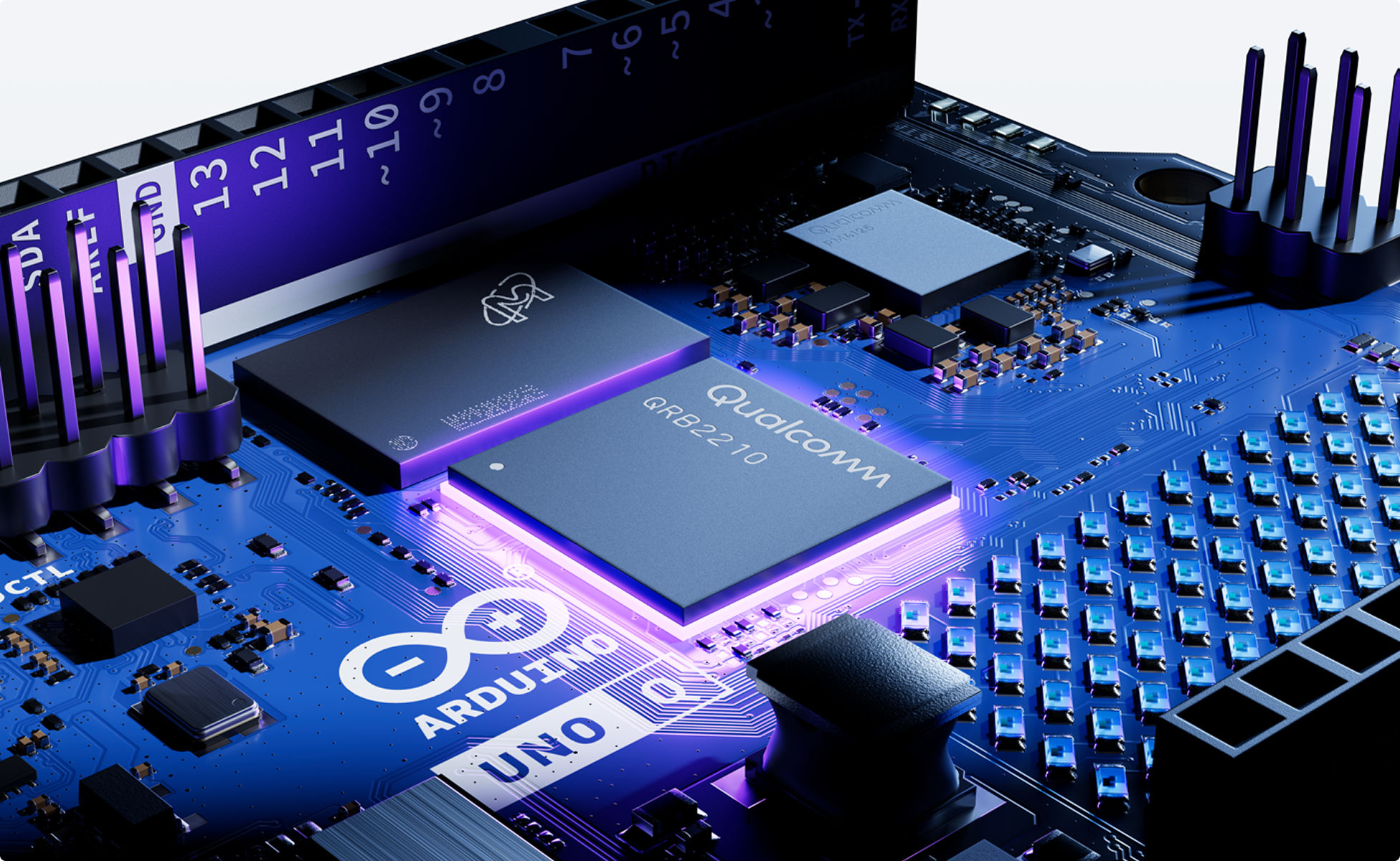
Arduino® UNO Q by Arduino is designed to make embedded system development easier for all skill levels and support a wide range of enterprise and non-enterprise application types.

The UNO Q is powered by the Qualcomm® Dragonwing™ QRB2210 System-on-Chip (SoC) / Microprocessor (MPU) paired with a dedicated STM32U585 microcontroller (MCU). The MPU handles high-level computing tasks like AI inference, media control and connectivity, while the MCU ensures real-time control for motors, sensors, and low-latency signal processing.


UNO Q is a cost-effective, expandable developer kit designed to accelerate innovation. Fully compatible with the Arduino ecosystem, it supports effortless hardware expansion. With Linux Debian and Arduino App Lab pre-installed, developers get instant access to sample apps and AI models. UNO Q offers a solid foundation and flexibility for IoT and edge AI prototyping.

Arduino App Lab

Arduino App Lab is an all-in-one development environment that has been built for UNO Q to transform how developers, educators, and innovators create applications for embedded systems, Linux, and edge AI. Whether you’re building an AI-powered robot, a smart sensor dashboard, or a real-time voice assistant, App Lab streamlines your workflow.


Preloaded on UNO Q, Arduino App Lab brings together sketches, Python scripts, and AI models into unified applications—all managed from a single interface. Run it directly on the board or access it from your PC for flexible development. With prebuilt examples and intuitive building blocks called Bricks, App Lab makes prototyping and scaling fast and easy.

Arduino App Lab

Arduino App Lab is an all-in-one development environment that has been built for UNO Q to transform how developers, educators, and innovators create applications for embedded systems, Linux, and edge AI. Whether you’re building an AI-powered robot, a smart sensor dashboard, or a real-time voice assistant, App Lab streamlines your workflow.


Preloaded on UNO Q, Arduino App Lab brings together sketches, Python scripts, and AI models into unified applications—all managed from a single interface. Run it directly on the board or access it from your PC for flexible development. With prebuilt examples and intuitive building blocks called Bricks, App Lab makes prototyping and scaling fast and easy.


Hardware Overview

Benefits

Dual-Brain architecture with AI capabilities

The QRB2210 MPU handles compute and AI tasks like computer vision and automation, while the dedicated STM32U585 MCU works in parallel to provide reliable, real-time control of low-processing functions.

Flexible and familiar end-to-end development

Develop directly on the board or through your PC. Use Arduino App Lab to drag and drop Arduino Bricks, which combine Arduino Sketches with Python scripts, containers, and AI models.

Software support

Build classic Arduino Sketches in the Arduino IDE . Take advantage of the rich, proven capabilities of the pre-installed, open-source Debian OS tools, backed by ready-to-run sample apps.

Solderless and Expandable

Plug-and-play Modulino® nodes, sensors, and actuators via the Qwiic® connector or high-speed GPIOs. Tap into the Arduino Shield ecosystem or step up to the high-speed Arduino carriers for advanced peripherals. Stay connected with built-in Wi-Fi® and Bluetooth®.

Use cases

AI and Vision

Analyze images or videos, perform object detection or image classification for security surveillance or product quality control, or build scanners that read bar codes and QR codes.

Smart Sensing

Build IoT solutions to monitor and log data from sensors for air quality, motion, and weather forecasting, or control an actuator when an environmental threshold, such as a low soil moisture level, is detected.

Real-Time Control System

Combine fast MCU-based AI sensing and actuation with an MPU-powered dashboard for live tuning and visualization. Ideal for control theory, automation, and motor-driven systems.

AI Robotics

Enable real-time interactive systems combining vision models, dashboards, and actuators like servos or LEDs for smart assistants, interactive kiosks, and human-aware IoT devices.

Specifications

Processor QRB2210
Microcontroller STM32U585
MPU Operating System Linux Debian OS with upstream support
Memory 2GB or 4GB LPDDR4
Storage 16GB or 32GB* eMMC
Wireless connection Wi-Fi® 5 2.4/5GHz with onboard antenna Bluetooth® 5.1 with onboard antenna
Power supply From USB-C connector 5 VDC max at 3 A; Input Voltage (VIN): 7–24 VDC
Datasheet

Connect with our communities

Stay ahead of the curve

Receive the latest updates, exclusive offers, and valuable insights delivered through the Qualcomm newsletter straight to your inbox.

Stay ahead of the curve

Receive the latest updates, exclusive offers, and valuable insights delivered through the Qualcomm newsletter straight to your inbox.

Qualcomm relentlessly innovates to deliver intelligent computing everywhere, helping the world tackle some of its most important challenges. Our leading-edge AI, high performance, low-power computing, and unrivaled connectivity deliver proven solutions that transform major industries. At Qualcomm, we are engineering human progress.

Stay connected

Get the latest Qualcomm and industry information delivered to your inbox.

Subscribe
Manage your subscription

© Qualcomm Technologies, Inc. and/or its affiliated companies.

Snapdragon and Qualcomm branded products are products of Qualcomm Technologies, Inc. and/or its subsidiaries. Qualcomm patented technologies are licensed by Qualcomm Incorporated.

Note: Certain services and materials may require you to accept additional terms and conditions before accessing or using those items.

References to "Qualcomm" may mean Qualcomm Incorporated, or subsidiaries or business units within the Qualcomm corporate structure, as applicable.

Qualcomm Incorporated includes our licensing business, QTL, and the vast majority of our patent portfolio. Qualcomm Technologies, Inc., a subsidiary of Qualcomm Incorporated, operates, along with its subsidiaries, substantially all of our engineering, research and development functions, and substantially all of our products and services businesses, including our QCT semiconductor business.

Materials that are as of a specific date, including but not limited to press releases, presentations, blog posts and webcasts, may have been superseded by subsequent events or disclosures.

Nothing in these materials is an offer to sell or license any of the services or materials referenced herein.